1. August 1939: A trip to Germany cut short

During the second half of August 1939, Father, Mother, my little sister and I were on the German island of Borkum. Father had saved some German money, but he wasn't allowed to repatriate it to Holland. However, we could spend it in Germany. That's how we came to spend our holiday in a family hotel in Germany.


Image result for borkum 1939

A postcard from Borkum dated 1939


My memories of this time are sketchy, though I do remember the owner of the hotel did magic tricks. He would hold a handful of scarves in his hand and all the children were mesmerised as they magically changed colour.

There was a radio in the hotel lounge. We were only allowed to listen to German stations. Father, always a contrarian, promptly switched to the Dutch Radio Hilversum. The hotel owner protested vehemently, to no avail. All the German guests quickly left the room in fear. By that stage, they were already heavily under the Nazi yoke.

Though the children enjoyed playing on the beach every day, I believe Mother would have preferred a holiday somewhere else. We were probably there because Father insisted.

In the dunes behind the beach, the military had installed listening devices with enormous horns that looked like gigantic old-fashioned gramophones. They believed this apparatus would enable them to hear approaching enemy aircraft. At that stage, the Germans had no radar. A sentry guarded the installation.

"Look, Carel," said Father, "See that German soldier. Remember his uniform well, because it will be a very long time before you see another one."
Father

Father sometimes got things completely wrong.

When the threat of imminent war became real, my parents decided to cut the holiday short and return home. It turned out to be the right decision, because the Germans closed the border the next day. Everybody seemed to be leaving Borkum. Luckily we still managed to get on board the little steam tram to the harbour. It was crammed full of people and their belongings and a second engine had to be hooked on when the first one wasn't able to pull the heavy load on its own.

At the harbour, a huge crowd were all trying to get on the boat to Emden. The gate to the quay was closed when the boat was full, and still the crowd kept pushing forward. Luckily we were already on board and we watched from our vantage point on deck. I still remember hearing the cries of the small children getting crushed against the gates. Many of the people were enlisted Germans who had to join their units. Others were families just like ours, who simply wanted to get home as fast as possible.

Eventually the boat took off, after scratching the side with a terrifying creak. The waters probably weren't at all safe because the helmsman never stopped searching the surface ahead. Presumably the Germans had already mined their side of the Dollard river.

When we arrived in Emden, things were a little calmer, though we had to wait a very long time for a train to Groningen. We arrived home in Naarden late that night. My parents discovered they had somehow lost the house key. Father borrowed a bicycle and rode to our housekeeper's house to get her key. Meanwhile, Mother laid us down in the garden and covered us with coats. Of course it was all too exciting to go to sleep.

Two days later, Germany invaded Poland. A couple of days after that, England and France declared war against Germany.

The Second World War had started.

2. The May Days of 1940, when the Germans invaded the country

On 10 May 1940, I woke at about 5 am to the heavy drone of planes flying low over our house.  I had never heard anything like it before.  I went to my parents' room to wake them.  

Mother got out of bed.  

Father just said, "Well, then, war must have broken out," before rolling over and going back to sleep.

He had to get up early every morning to get to his office in Amsterdam and he didn't like to be woken up earlier than necessary. That morning he left for work as usual around 7 am, as if it was a perfectly normal day.

The rest of us saw the world somewhat differently.  People were milling about in the streets.  The police came to arrest members of the NSB (National Socialist Movement).  

The NSB were considered to be traitors and troublemakers.  

That day, and also the next couple of days, we didn't go to school. 

Radio announcements became ominous.  Every day the German army penetrated deeper into The Netherlands.  There was fighting as far west as The Hague and Rotterdam.  The front came terrifyingly closer.  

It had been decided that the fortress of Naarden was to be defended, whereupon our neighbourhood, the Rembrandt quarter, would be in the direct line of fire.  The entire area was to be evacuated the following day. Months before, everybody had prepared for evacuation by packing a suitcase with essentials.   My sister and I each had a little green backpack.  My parents considered taking a taxi to Haarlem in order to move in with Mother's parents until the danger passed.  Haarlem was considered to be safer than Naarden. 

In the end, nothing came of my parents' plans.  The Dutch army capitulated on May 14, by which time the German army was already in Amersfoort.

After that, the turn of events completely reversed.  Members of the NSB were freed from jail, we went back to school, and life appeared to return to normal.

Shortly afterwards, two little girls came to stay with us.  Their father, an army sergeant, had been wounded in the fighting in Grebbenberg and was in hospital in Wageningen.   His wife wanted to visit him daily and could only do this if somebody looked after the daughters.  After a couple of weeks, the patient was discharged and the girls went home again.

3. 1940: Fighter planes shot down and the National Socialist movement gathers steam

I don't really remember much about the first year of the Occupation. After all, I was only 10 years old when the war began in The Netherlands.

At first, after the Dutch capitulation on 14 May, not much changed in our day-to-day lives. If I remember correctly, the blackout had already been implemented earlier. Black paper rolls were installed on all the windows, and these were pulled down at night. From the outside, you weren't allowed to let any light escape from inside. The authorities imposed considerable penalties for non-compliance.

Street lamps had tiny bulbs that gave off just a pale glimmer of light. Car and bicycle lamps were allowed to shine only a narrow strip of light, sufficient to see an approaching vehicle, but wholly inadequate for the driver to see where he was going.

The Germans requisitioned many school buildings, including the Christian school and several secondary schools. Later, German officers were sometimes billetted at civilian homes, although this was an exception.

Gradually, necessities like food, clothing, shoes, bicycle tyres, etc. were rationed.  However, there wasn't any real shortage, provided you had enough money. 

At that time there was considerable poverty in The Netherlands. Although it was strictly forbidden and just as strictly enforced, poor people often sold their ration books in order to to get by.

During the first May days, a German fighter plane was shot down in 's-Graveland. Father and I rode our bikes over to take a look. The plane was completely destroyed. Pieces of metal lay scattered all over the place. I remember that Father found an aluminum seat, presumably belonging to the gunner. 

Later, a British bomber suffered the same fate and went down in Eemnes; I went with some of my friends to look at the crash site. According to reports, the crew had bailed and gone underground. That was the term used to describe people in hiding, although in reality this particular crew were high and dry in the loft of a farm. As far as I know, the Resistance movement helped them get back to England through Belgium and France. 

Years later, a nurse told me she had climbed up to the loft to ask if there were any wounded. In French, 'wounded' is 'blessé'. Her English wasn't very good, and she asked whether there were any blessed people. I'm sure the response was resoundingly positive.

In that first year, I remember a school outing to Valkeveen, a large conservation area nearby. It turned out to be our last one. As there was no motor transport, we walked the whole way, a distance of some 5 km, and back again. Although we didn't mind having to walk so far, we were all exhausted when we came home at the end of the day.

As children, we hardly noticed that the Germans were already picking up people.  In the beginning, they would arrest mainly members of the Resistance, though that was to change.

Cars started to disappear. At first this was because it was difficult to obtain petrol. Later, the Germans seized all the vehicles they could lay their hands on. In the beginning, doctors were still allowed to drive so they could continue their house calls. 

We had great fun on the largely empty streets because we could cycle and rollerskate wherever we liked. During the first winter, when there was snow, we would sled behind the few cars still on the road. You could lie on your stomach with both hands firmly holding the bumper, or you could sit on your sled with a length of rope looped around the bumper. You had to hold onto the loose end, and let go when you had had enough. Drivers usually allowed us to do this. Actually, they didn't really have much choice, because even if they didn't like it, the pesky kids would still stick to the back bumpers like flies.

Father sometimes brought home 'Wehrmachtswurst' (Wehrmacht sausage). This was a rare black market treat that he'd buy clandestinely, but occasionally he would receive meat as a gift from German officers who were private clients at the bank where he worked.

The black uniformed Dutch WA soon made its presence known.

The WA (or Weerbaarheidsafdeling) was the paramilitary arm of the national socialist movement. They were ruthless members of the NSB, who specialized in terrorizing people. 

They particularly liked to victimize Jews. The Dutch didn't take this lying down, however, and in Amsterdam and other large cities, there were many skirmishes. 

In Amsterdam, one particular WA member named Koot was bludgeoned to death. Very soon the following song became popular:

Sla hem dood,
Net als Koot,
Sla hem op zijn mieter!

Punch him dead
Just like Koot
Beat him to a pulp!

One day I was walking with Father in Paulus Potterstraat in Bussum, when a WA platoon came marching in our direction. Father started to whistle Mondschein, a German tune. 


This was clear provocation on his part, because, as everybody knew, the tune also had extremely anti-NSB lyrics. I still remember the men peering at Father from under their caps. Of course, it was also very foolish of Father to do this. The commander could quite easily have ordered his men to beat him up, something they would have been only too happy to do.  Fortunately nothing happened.

The song went like this:

Op de hoek van de straat staat een NSB-er,
Met een krant op zyn buik staat hij daar te venten
En verkoopt zijn "Vaderland" voor vijf luttele centen.

Volk en Vaderland

On the street corner stands an NSB-man
Holding a paper he is vending
Selling his "Fatherland" for just five cents.

(The national socialist movement, the NSB, had its own propaganda publication titled 'Folk and Fatherland', which cost 5 cents).

As far as I can remember, the first real war action in our town didn't start until the end of 1940 or the beginning of 1941. One Sunday morning a British aircraft dropped a bomb in Bussum about 1 km from our house. Oma von Ziegenweidt happened to be visiting that weekend.

The air raid alarm didn't go off till after the explosion. I always found the sirens frightening. Mother hastily sent us into our miniscule cellar, which was only half underground and couldn't possibly have provided any real protection. Oma also squeezed in and by then the small area was completely full. There was no room for my parents.

We waited about twenty minutes before the all clear sounded and Mother let us come out again. Later we discovered the bomb had been intended for the Christian School where Germans were billeted. 

Unfortunately, the bomb missed the school, hitting the house next door instead. It fell through the roof, and exploded in the bathroom on the second floor. The owner had just been in the bathroom and was in the adjoining bedroom at the time of the blast, which blew the entire roof off the building. Luckily she survived.

In retrospect, perhaps we overreacted to this one explosion. As the war years progressed, my attitude to danger changed greatly.

4. 1941: The German grip tightens and Jewish children disappear

In 1941, Father was promoted to Manager of the Bussum Branch of the Bank of Amsterdam. We were given the apartment above the bank at 2 Stargardlaan to live in. After the house was renovated and painted with a water-based paint (oil-based paint was no longer available), we moved in.


The house today. A gable has been added to the roof and the building has been converted into apartments. 

The house had many spacious rooms. There was a large garden at the back and a little cottage for the caretaker. There was a bicycle stand for bank employees, as well as two large garages. One garage served as an archive for the bank's records. Our family stored our bicycles in the other one, which we also shared with Mr Merckx, the caretaker. Our front door was at the back of the main building, making it difficult to find. Later this turned out to be an advantage for us.

Gradually the Germans tightened their grip on the country. Workers were sent to Germany to the armaments factories. At first, people signed up voluntarily, but later most were conscripted. They had little choice but to go to Germany. If they refused, they were sent to punishment camps. If they went into hiding, their ration books were withheld. The loss of income would doubly punish the families. Workers considered themselves quite lucky if they were put to work at military installations within The Netherlands. Not only were they closer to home, but in Germany there was always the not insignificant risk of death from Allied bombing raids.

Students were forced to sign loyalty oaths to the Germans. Those who refused were also sent to Germany. Many students went into hiding if their parents had the means to support them.

The persecution of Jews started to pick up. First they had to wear a large yellow star. Later they had to be registered, and subsequently deported to camps in Amersfoort and Overijssel. From there, they were transported to Germany. What happened to the Jews there is now well known, but not back then. People must have had an inkling though.

Some Jews were able to go into hiding. It was very risky to provide shelter to Jews. Also, Jews had to have considerable means to be able to afford to go into hiding. Not only did they have to pay for their hiding place, but their food could only be bought on the expensive black market. Of course, ration books were not available to them.

A number of Jewish children went to my school. Almost from one day to the next they all disappeared.

I only ever saw four of my Jewish classmates back again after the war: Jack Koppels, Jettie Sittard, and Alfred Josephus Jitta [died in a motor accident in 1966] and his sister Carla.

Jack lived near our house and we often played together. He had an electric train, a Marklin Track 0, and he played the jazz piano tremendously well. Jack's parents also survived the war; his grandparents on the other hand, did not. Jack, his grandparents and a number of other Jews all went into hiding in a house in Laren. Somebody betrayed them and the Gestapo raided the house. Jack hid in a cupboard and wasn't detected, but everybody else was arrested and deported to Germany.

Father somehow managed to find Jack a new safe house in the Province of Friesland and personally brought him there by train. This was risky because Jack didn't have an identity document. If he had been discovered, both Jack and Father would have been arrested. When the new address in Friesland became unsafe a couple of years later, Father brought Jack back to Bussum. I happened to be away at the time, and Jack, without my knowledge, slept in my bed for two nights. For safety reasons, my parents didn't tell me this until after war.

Alfred Josephus Jitta and his sister were deported to Theresienstadt, where the chance of survival was a little better.

Jews who were sent there tended to be more affluent, probably by virtue of substantial 'donations' to the German cause.

The Germans closed off the main road between Bussum and Crailo to civilians during the war. General Christiansen had established the German headquarters in a large villa about halfway along the highway.
General Christiansen, Supreme Commander of the Wehrmacht in the Netherlands 


The inside of the Bosch van Bredius Hotel, in which the Germans established their headquarters

To prevent sabotage, a large area, including the main road, was declared off-limits. If you wanted to cycle the short distance from Bussum to Laren, you had to take the much longer route via Blaricum instead.


At first we didn't pay too much attention to the German army. A number of school buildings were requisitioned and troops would march through the town singing loudly. We were told to ignore the soldiers, although it was impossible to resist secretly peeking at them.

In our spare time, we often played football on the playing field in Bussum. Every now and then the Germans would kick us out so they could train there. Usually they would do physical exercises, which incidentally were extremely strenuous. If a recruit wasn't able to do exactly what his superiors required, he would be punished with 'frogging', which entailed marching with his heavy rifle in his outstretched arms. After 25 metres they would be so exhausted that they could hardly remain upright. Even we would sympathize with the plight of these 'Krauts'. The soldiers practised attacking and defending in the fields outside the town. Sometimes they would use heavy anti-tank cannons, which the soldiers had to drag up and down themselves In order to keep the cannon in balance during transportation, a soldier had to sit on the end of the barrel. This was always funny to watch, because his legs would just dangle in the air.

Very early on in the Occupation, the Germans ordered us to hand in all radios. This was to prevent people listening to the BBC. At first the Bank of Amsterdam was allowed to keep its office radio to listen to the stock exchange news. From the beginning, the Germans drowned out British radio signals with heavy static. However, with a special antenna it was possible to overcome this. Father had hidden in his office a wooden frame measuring about 45 x 45 x 15 cm, wound with copper wire. One end of the copper wire was attached to the radio. By turning the frame, the static could be strengthened or weakened. Under favourable conditions, despite the interference, we were often able to listen to Radio Orange broadcasts via the BBC.

Father often listened to the office radio, and not only for stock exchange news. Strangers couldn't be trusted, so he usually listened at night. But I still remember Mother severely berating Father one time for listening to the BBC during broad daylight, when clients could quite easily have heard what he was doing!

5. The Occupation Around 1942: A plane crashes nearby, alternative fuel sources, and Father gets into trouble

One winter evening at dinnertime we heard an approaching plane. It was flying unusually low, its motor was sputtering and it appeared to be in difficulty. When it was very close overhead, the motor suddenly died.

"That one's about to crash,” I predicted, and I was right. Moments later we heard a dull bang.

Although it had sounded very close, it actually landed quite far from our house. In the distance we saw fire. Father and I immediately cycled over to take a closer look. 

It was a German fighter plane that had crashed in the heavily populated Bussum-Zuid area, on the gym hall of a local school. The motor had come off on impact and landed against the side of a house on the other side of the schoolyard. Quite a few other houses were damaged too.

Luckily there were no casualties other than the pilot, who was killed on impact. Bystanders told Father that a couple of fingers had been found. The gym hall burned down completely.

Presumably the pilot had tried run into mechanical problems and tried to reach the military airfield in Soesterberg, since he would have been well aware of the danger of an emergency landing in a pitch-dark built-up area. Unfortunately for the pilot, his attempt was unsuccessful.

This story is corroborated by the entry on the site Back to Normandy

More often than not, planes that came down belonged to the Allies. I remember a fleet of high-flying bombers on their way to Germany. It was broad daylight and we were outside at the public swimming pool in Naarden. We clearly saw the planes against the blue sky. Dotted about were small white clouds of exploding anti-aircraft fire. Suddenly we saw two bright flashes, and we knew immediately that the bombers had been hit. I'm sure the crew was killed on impact. Mother had also seen it from our house in Bussum and was still very shaken when I came home.

In order to supplement the food shortage, I started growing vegetables and potatoes in the back garden for our family. I kept this up as long as possible, though it wasn't always possible to get hold of seed or seedlings. As a result, I wasn't able to grow enough cabbage and other winter vegetables in the last year of the war, when the food shortage was at its most desperate.

As there was no gasoline, taxis and buses used wood gas instead. Taxis carried an enormous bag in a metal frame on their roof. This bag could be refilled at the garage:


Buses needed far more fuel and pulled a two-wheeled trailer with a wood gas generator:


At last drivers were real chauffeurs again, because their job involved keeping the fire going underneath the generator. Horse-drawn carts also made a comeback. Oma Zuydweg (my maternal grandmother) once even treated us to a ride in an open carriage to Bikbergen and back.

A large, partially submerged bomb shelter was built on the square in front of the railway station. The shelter was lined with wood, over which zinc corrugated sheets were laid. A metre-thick layer of soil covered the entire structure. Inside, long wooden benches lined the sides. 

Unfortunately the shelter was vandalized, so the municipality instituted a citizens' nightwatch. Father was called up too.

Father always tried to get out of it, but somehow he never managed to avoid doing his duty.

One evening, street inspectors noticed a dim light coming from my parents' bedroom. Father was given a fl 50 (guilder) spot fine. This was a considerable amount in those days. He considered his punishment to be very unfair because there was a huge wardrobe in front of the window and not much light could possibly have emanated. Somebody had probably forgotten to close the curtain. 

Against Mother's advice, Father decided to appeal his fine. The judges in those days were all pro-German and did not hesitate to impose heavy penalties where they even suspected the defendant might have been in the wrong.

Father was told he had neglected to set a good example in his professional capacity as bank manager. Accordingly, his fine was increased to fl 70. 

Father was livid!


----
Footnote: A real mystery!

In the YouTube video below is an interview with a man (a couple of years younger than Carel), who also remembers the plane crash in Bussum. He claims there should have been 4 crew on board.

He collected some pieces of metal from the wreck. There is footage of the townspeople standing around and the firemen putting out the fire (at the 9.06 mark). His account starts 5 minutes into the interview. At 12.01 you can see the buildings today, including the chimney that the plane hit, with clear marks from the accident.

From the YouTube blurb:

"In World War II on 30th December of 1942 a German Dornier 217 crashed in Bussum The Netherlands. Henk van Dijk was a young boy of 8 years old he remembers the enormous bang that sounded all over the village. The pilot was 'H Brockhagen' the other people in it (estimated 4) have never been mentioned, not even by the German war authorities. The plane came closely over the houses and touched a roof and a chimney in de Keizer Otto street. That chimney still shows the marks where the plane hit it.

Then it steeply turned and crashed into the gym of a school.

Was the plane and its crew/passengers trying to escape to England? Until today it remains a mystery."


6. 1943: Playing with fire

As the years went by, the Allies stepped up the pace of their bombing raids over Germany. By 1943, hundreds of British bombers would fly over The Netherlands on their way to Germany a couple of times a week. This usually happened in the evenings, generally when I was already in bed. 

The Germans had set up searchlights and anti-aircraft ranges all round Amsterdam. The resulting light show was spectacular. 

From Bussum we could see the searchlight beams and I often got out of bed to watch. They shone very high into the sky in search of enemy aircraft. If a searchlight managed to detect a plane, a second and perhaps a third beam would immediately be added, reducing the victim's chance of getting away. 

Of course, he would also be blasted with heavy rounds of anti-aircraft fire. A couple of minutes later, as the fleet reached the skies above Bussum; you would clearly hear the hum of British engines. That would give us hope because we knew that in a couple of hours Germany would be on the receiving end of a good blasting.

In 1941, when bicycles were beginning to become scarce, Father bought two new bikes: one for himself and one for me. He stored them temporarily at the house of a distant cousin in Zierikzee. At the time, his own bike was still in reasonable condition and he considered me too young for a new one. For years, Father had managed Cousin Anna Couvee's money and one day he decided to pay her a business visit. He let me accompany him. We were also to bring my new bike back home.


First we took the train from Bussum to Rotterdam, and from there in Roosenstraat, we caught the steam tram via Oud Beyerland to Numansdorp. A ferryboat then took us via St Philipsland to Zijpe on the Isle of Duiveland, where a steam tram was standing ready to take the passengers to our final destination in Zierikzee. The 150km trip took the entire day. 

We stayed a whole week with Cousin Anna. Father and I slept together in an antique four poster bed. While Father busied himself with Cousin Anna’s financial affairs during the day, I would make trips on my new bicycle to places like Zonnemair and Schuddebeurs.

We took a different route for our return to Bussum. We first caught the steamboat from Zierikzee to Rotterdam. Just outside the Zierikzee harbour, we were guided along the way by two little German naval vessels. A couple of weeks later, Allied fighter bombers sank them both.

Just before the bridge at Moerdijk we turned left into the Dordtse Kil. Suddenly we were startled by a bombing of the bridge. Enormous fountains of water shot into the air. For a moment we wondered whether we would be the next target, but luckily we were spared.

To jump ahead a little, first the following story:  Towards the end of the war, when Cousin Anna had long ago been evacuated together with all the other inhabitants of Zierikzee, a bomb fell just behind her house, bringing down the back of her house and revealing a brand new bicycle in the attic. The Ortskommandant immediately confiscated it for his own use and was seen riding around on it during the last months of the war. He probably took it back to Germany because Father never saw his bike again.

Present day Gerard Doulaan, Bussum
One afternoon I was playing close to home with my friend Kees Groenendaal in Gerard Doulaan, when two fighter planes suddenly appeared out of nowhere, racing close to each other very low over the roof tops. The one in the rear, a British fighter, fired furiously at the plane ahead. Although it only lasted a couple of seconds, the noise was deafening. 

Immediately afterwards everything was quiet again. 

I'll never know if the German plane was hit. 

Unfortunately, the daughter of Father's co-manager Mr. Stal was standing at the back of her home a little further up the road at the time. She was hit in the stomach by a machine gun bullet and died of internal haemorrhaging soon afterwards.

During the skirmish, a half-metre round of machine gun bullets and a couple of unexploded grenades fell to the ground from the British aircraft. The latter were about 2.5 cm wide and 15 cm long. This was live ammunition!  A boy had found the ammunition on the roof of a garage and later gave it all to me. My friend Dick Geuzenbroek later defused it. He pulled the bullet out of its casing with pliers, poured out the powdery explosives and replaced the bullet. It was so simple and I watched him doing this with fascination. I was aware though, that the percussion caps were still intact and an explosion would result in the loss of a couple of fingers. I forget what happened to the grenades.

A long time after the war, my brother brought the machine gun bullets as well as some other ammunition to the police headquarters in Bussum. He had packed everything in a grocery bag and took it with him on the back of his bicycle. 

At the police station, he dumped the bag in the middle of the duty sergeant's desk. 

The poor man casually opened the bag, but immediately recoiled in horror when he saw the contents!

7. 1943: Suspicious suitcases, and what the Germans really believed

Life became gradually more difficult. Not only food and clothing were rationed, but energy was also in short supply. Once the permitted allocation of piped gas or electricity had been used, the authorities would cut off the supply. In later years, gas and electricity were only available at certain hours of the day, and by the end of 1944 the supply dried up completely. After that, we had to find our own means of cooking our food. By then we had also learned to live without heating because anthracite and fire wood had become completely unavailable.

Railway services were restricted more and more as the war progressed. In the beginning we still had electric trains. Later, after the Germans confiscated the copper overhead lines, trains reverted to steam.

A small concrete bunker was built on top of the tender of each locomotive for the safety of the machinist and the stoker. Although I was lucky never to encounter an aerial attack myself, from 1943 onwards, it wasn't unheard of for trains to be shot at. If a passenger train was about to be attacked, the fighter planes would first either fire a warning round along the tracks or otherwise simply fly low overhead. After the train stopped, the passengers would run as far as possible in search of cover. Behind each train there was often a flat bed truck with FLAK, German anti-aircraft guns.

In The Hague, the Germans cleared out large areas. Oma von Ziegenweidt (Father's mother) lived at van Nijenrodestraat 91. 

Present-day van Nijenrodestraat 91, The Hague

Father, anticipating the forced evacuation, made a number of trips to The Hague with me to pick up Oma's belongings. We would each carry two empty suitcases, and return to Bussum fully loaded. Our plan was that Oma would come and live with us if she was forced to leave her home. During one of these trips, as we were waiting at the station, an inspector ordered us into his office on the platform. 

He wanted to see if we were smuggling food or other contraband into The Hague. Father suddenly appeared to be in a terrible hurry and this naturally made the man even more suspicious. We first had to open the large suitcase. Inside it was a smaller, empty suitcase. Mine was the same:inside, there was also a small, empty suitcase. The inspector's suspicions weren't completely allayed, but he had to let us go.

Soon after, Oma moved to Bussum. I don't know how her large pieces of furniture were transported. Presumably they came by rail.

In spite of all the German victories in the first years of the war, we were convinced the Allies would eventually prevail. 

At the bank, Father sometimes met with high-ranking German officers, who would tell stories about the inexhaustible Russian army. The Wehrmacht destroyed untold numbers of tanks, but there were always new ones to take their place. It was the same with the infantry. 

Confidentially the officers told Father that the turning point of the war had already occurred in 1941. Later we realised this was true.

During the summer we made a number of trips to Lienden in the Betuwe area. We first took the train from Bussum to Amersfoort and from there we took an electric tram to Rhenen, where we caught the ferry to the other side of the Rhine. 

After that it was just a half-hour walk to Mr. Elings, one of Father's business associates. 

Elings bought 'fruit on the tree': this meant he paid the farmer for it at the beginning of the year. This gave him the right to pick it all but he had to transport it to the auctioneers, where it was sold to wholesalers. The public could buy only very small quantities - with ration coupons. 

At the source however, there was no control. We could fill our suitcases and boxes to the brim with fruit. The difficult part was bringing it all back home. There were often inspectors near the ferry who wouldn't hesitate to confiscate anything they found. On one such a trip, we had already seen them standing on the riverbank checking everyone boarding the ferry.

The land around Rhenen. The bridge in the background was built in 1955. A railway bridge from 1883 was destroyed during the war. This is why they had to travel by ferry to get to the other side in 1943.

That day on the way home, we first walked a short distance along the outer dyke, before crossing the foreshore and creeping surreptitiously towards the inner dyke which lay much closer to the river. Between the inner dyke and the river little shrubs and bushes were dotted about, providing us with some shelter from the sharp eyes of the inspectors standing on the road above the ferry. The ferryman, on the other hand, did see us. We approached slowly and when he signaled that he was about to leave the shore, we ran as fast as we could with our heavy load to the ferry and managed to leap on board just in time. The inspectors couldn't to do anything.

In September I started at the secondary school. The school building was occupied by the German army and our school was temporarily housed in the Christian school, the same building that had been evacuated for the German soldiers three years previously, and which had been the target of the bomb that had hit the house next door. We had to share the building with the Lyceum, another secondary school. One week we had our lessons in the morning and the Lyceum pupils had theirs in the afternoon, and the following week the order was reversed. This went on until September 1944.

In primary school I had already learned quite a bit of German. At the secondary school, German was heavily emphasized. English was considered unimportant, and wasn't taught until our third year.

8. The Occupation between January and August 1944

The evening curfew started at 8 pm and you had to make sure you were indoors before then. I would sometimes visit my friend Adriaan Zanen after supper to do homework together. He lived at the corner of Brediusweg and Paulus Potterlaan. 

In the winter it would already be dark by then. Usually I would cycle over. Like all other bikes, mine had a dimmed lamp giving off just a little beam of light, just enough for oncoming traffic to see the cyclist in time, but wholly inadequate for the cyclist himself to see where he was going. For safety reasons, I always made sure I stayed on the cycle path.

One evening, I accidentally rode my bike right into a group of people standing outside a German military nightclub. I shouted, "What stupid idiot just stands on the bike path?"  

The reply came back in German, accompanied by a kick in my behind. I realized I had ridden into a group of German soldiers chatting up some local girls.

One day I was working in the vegetable garden when I heard the distinctive noise of an approaching V1 flying bomb. The sky was overcast and there was nothing to see. 


Suddenly the motor stopped, which meant the flying bomb had started its downward glide. Knowing it would soon hit the ground and explode, I crouched against the wall of the caretaker's building, making myself as small as possible. 

I don't know what happened to the bomb, because I never heard an explosion. Presumably it simply flew on ahead and made a soft landing in the marshy Naardermeer without exploding.

Adriaan Zanen and I often took long walks through the moors and the woods between Huizen, Blaricum, Laren and Craayloo. Later, when leather for shoe soles became scarce, we had to stop these wanderings. 

Eventually the situation became so bad that our shoemaker would resole shoes only on prior payment of not only money and ration coupons for leather, but also food for him, which was in extremely short supply.

In our apartment above the bank we had a large pantry with built-in cupboards. Long before the German invasion, Mother had started to stock up and continued to do so until everything was rationed. She always tried to replace whatever we consumed with new supplies so nothing would go bad. 

This turned out to be very sensible and we benefited greatly. The difficulty, of course, was that nobody knew how long the war would last and how long our food supply would need to last. 

In the last 'hunger winter', we had almost nothing left to eat.

9. September 1944: Crazy Tuesday

September 5 became to be known as "Crazy Tuesday". It was a day when the wildest rumours spread. They became stronger and stronger: “The Allies have arrived in Brabant!”; “No: they're in Rotterdam!”  Others claimed English troops had been seen in Leiden. 

The rumours were so convincing that many members of the NSB fled. 

Even German soldiers started to become nervous and departed for the East. 

Later we realised the rumours were completely unfounded. But I do remember how excited the whole family became with the idea that we were to be liberated in a matter of hours.

On September 17, the day of the landing of the British near Arnhem, Queen Wilhelmina was on Radio Orange calling for the railways to go on strike. This had serious consequences. The Dutch railway system was paralyzed and caused the Germans a number of logistical problems. 

It also caused great hardship for the Dutch railway workers who were left without pay as they had to go into hiding from then on until the end of the war. 

Many of them were replaced with German railway workers in order to get the military transportation system working again. Of course by then, passenger transportation had ground to a halt.

There was a railway bridge across the Karnemelksloot in Naarden, which the Resistance sabotaged one night, causing a train to derail. The steam engine could be seen hanging precariously from the bridge, just short of falling in the water. 

All rail transportation from the province of North Holland to Germany was held up. 

The Germans were quick to retaliate. A house close to the damaged bridge was set alight. It belonged to the Jewish parents of one of my classmates. The Germans forbade the fire brigade to do anything until the house was fully engulfed in fire. I found it very tragic to see a beautiful house being purposely destroyed.

Source: http://naarden-bezetting.blogspot.ca/


---
Footnote:

The story about this period is described more fully (in Dutch) in a typewritten 1989 account on http://stichtingvijverberg.nl/Downloads/Omroeper_198902_LR.pdf

Because of the rumours about imminent liberation on September 5, NSB members and Nazi sympathizers were in such a panic that as many as 65,000 people fled.

From September 17 to 27, the Allies tried to capture the bridges over the Rhine around Arnhem, but the Germans were well organized. On the 26th, the British were forced to retreat.

The Resistance stepped up its activities during this time. The Germans didn't take any half measures with their reprisals. Many completely innocent people were shot on the spot or and tens of thousands of men were sent to labour camps.

The house in this story was in fact a large duplex described as a villa on the Juliana van Stolberglaan. #116 was occupied by a Mrs. Goldstein-Van Zelm, who wasn't Jewish herself but married to a German Jew. The Germans ordered her to leave the house immediately, though after she showed her German passport to the Germans, they moved on to the next door house (#114), where the family Hamers lived. 

This family had two sons, aged 17 and 21. Mr. Hamers was terrified the Germans would shoot or arrest the two sons. After searching the house, they gave the family ten minutes to leave.

In their panic, all the family brought with them were some coats, religious books and a chair. Mr. Hamers had previously received a large insurance payout and had hidden it somewhere in the house.They completely forgot to bring this money and their jewellery, and ended up losing almost all that they had in the fire. 

After the war, it was discovered that Mrs Goldstein-van Zelm had hidden many Jews in her house, including two living there at the time of the reprisal. I wasn't able to find out whether they escaped the fire. 

It appears the Hamers were renters. Their house belonged to a national socialist, who had bought it from a Jewish family, Gerrardus and Esther Vita-Israel, who were deported to Sobibor, where they died in 1943:


The Hamers were not Jewish, and there is a claim in a post-war publication that they were national socialists themselves. This claim was vehemently denied by the family's two sons.

Mr. and Mrs Goldstein-Van Zelm had two children, Edgar Ernst and Jenneke Ruth. It's unclear where they, or Mr. Goldstein, were at the time of the fire. The couple divorced in September 1945


Putting the two accounts together, it's not clear whether the "Jewish parents of one of my classmates" refers to the family Vita-Israel or Mrs. Goldstein-van Zelm. However, there is no mention of the Vita-Israels having any children.

In the days after the fire, hundreds of residents came out to look at the burned shell of the house, which was rebuilt in 1948. 

10. October 1944: the Germans search the house

This poster orders males aged 17 - 40 to present themselves for labour. At the bottom it states that all those who try to flee or resist will be shot. In the accompanying story, it states that the order includes all males aged 17 to 50.
Source: http://gooiland.50plusser.nl/?page=article&warticle_id=104073&RAZZIA-TE-NAARDEN-OP-24-10-1944-1#.WiM6BUpKuUl

Those who presented themselves were sent to Arnhem to dig trenches, among other tasks. Bob Lambooy’s father was in this group. Apparently he soon regretted his decision, because one night about a week later he knocked on our door after curfew and asked if we could give him shelter. We immediately let him in.

He had fled from Arnhem and spent the entire day walking back to Bussum. On the way he had to be extremely careful not to be spotted by the authorities. It was particularly risky to be caught out after curfew, which was only allowed if you had an "Ausweis".  “Uncle Al” Lambooy slept in a spare bed in my bedroom. He only dared return home after about three days. We had already informed his wife the next morning that her husband was hiding at our house.

Some background about “Uncle Al”: In 1939/40, he had been attached to a Dutch Army bicycle squadron, where they made daily journeys of about 250 km on heavy bicycles without gears. If this was impressive, their fire power must have been the opposite. Armed with carbines only, they were no match for the Germans with their automatic weapons.

The Wehrmacht cordoned off our area. Nobody was allowed on the street. German troops searched all the houses for men aged between 16 and 60. We had foreseen this, and as a precaution, Father, who was 47, and some of his neighbours in a similar predicament, had taken to sleeping under the floor of the bank’s conference room. In the evenings they would go down, and emerge the next morning. 

Actually they quite enjoyed the camaraderie. They had mattresses, plenty of drinking water and crude sanitary provisions. Mother ensured the carpet and table in the conference room were rolled back over the trapdoor in the floor after the men had ‘gone to bed’. We children were not supposed to know about this, but my four year old brother once saw them go down. When he told me what he had seen, I told him he was on no account to tell anybody else.

Early on 24 October, the Germans rang the main bell of the bank. Since the bank was closed that day, nobody opened the door, and the soldiers left. A second time, however, they walked around the building, trying first unsuccessfully to gain access via the staff entrance. Then they found our door and rang the doorbell. Our housekeeper, Senta Willinger, went downstairs to open the door, as we were afraid the Germans would force the door if we did not open it. Senta was born in Germany and spoke fluent German. At first she tried to intimidate the soldiers by telling them importantly that ‘Herr VON Ziegenweidt lived there. Unfortunately, this did not have its intended effect. A couple of soldiers came marching up the stairs. Mother had made me put on shorts and told me to go play with my 8 year old sister and her dolls.

That day was my fifteenth birthday, exactly a year shy of the compulsory draft age. Mother distrusted the Germans and wanted me to appear as child-like as possible. When two soldiers stopped to talk to Mother in the hallway outside the living room I could not suppress my curiosity. I stood up and went to the hallway. Immediately a soldier came to me and asked “Wie alt bist du?” (how old are you?)  Mother went pale with fright and quickly told them it was my fifteenth birthday that day, whereupon the man laughed, put out his hand and said “Gratuliere” (congratulations). After that they looked about a bit, searched the toilet twice and then departed for the next house. They were regular Wehrmacht soldiers, and not the feared SS. Presumably they realised they would not be able to find any men in our home. But as soon as they were gone, Mother was furious with me. How could I have put myself in such a potentially dangerous situation!

Later Father told us they had seen the soldiers’ heavy military boots through the grille of the air vent as they marched up the steps to the bank. Only after the Wehrmacht had lifted the cordon around the area, did the men dare to emerge from their hiding place.

It was very important that hiding places be kept secret. Especially children and old people had to be kept out of the loop. Oma had long ago become terribly curious as to where Father hid. With a very serious face and with much secrecy, Father told her he had found an ingenious solution. We lived opposite the station, where trains no longer stopped and passengers no longer waited. The waiting room doors were not locked, and you could still go in. “Nobody will look for me over THERE, so every time the Germans come by, I will go and sit quietly in the waiting room,” he told Oma confidentially. 

It wasn't long before Oma had told Miss Brouer and Senta the secret.

For me that 24th October had a very tragic end. Dick de Bruin, a friend of mine, lived at 17 Albrechtlaan. Dick was 16 and his father 45, so both were supposed to report for work for the Germans. 

Months earlier, they had made a hiding place for themselves under the floor of the toilet. I had heard that Germans would sometimes shoot through wooden floors in case people were hiding underneath them. I had told Dick I would personally prefer to hide above one of the dormers, rather than under the floor. The dormers had a flat top measuring about 1 by 3 metres. If you lay down flat nobody could see you from below as there was a little ledge.

11. November 1944: an attack on a train

One morning early we heard the unmistakable rumbling of plane canons. Fighter bombers were attacking a train stranded on the track, about 2 kilometers away near the Naardermeer. From the tram station I watched them diving towards their prey and then rising again in preparation for the next attack. After a while they flew off.

That morning I had to be at school at 11 am for our 'shift' in the Christian school building. By then we were sharing the building with three other schools. Around 10.40 am. I left home as usual, first jumping over the little wall in front of the garden at Prins Hendriklaan, where I met up with my classmate Kees de Roode. We walked down the street together. At Brediusdam a third classmate joined us.  

Our conversation was filled with the events of that morning. We were careful, because we suspected that the planes, after re-arming in England, would come back to finish off their target of the early morning. When we reached the end of Land Street, our expectations were confirmed. We saw four fighter bombers flying at an altitude of about 3,000 feet. They were flying in the opposite direction from the station. When we were almost at the school, the first plane broke formation and started to dive.

I still clearly recall the scene. One moment the schoolyard was full of pupils, all looking up. Then, all of a sudden, everybody ran inside as fast as they could. We three also took flight, running to a bicycle shop across the road. There were no longer any bicycles for sale, but the door was open. Without asking, we ran inside and dived down the basement stairs. A couple of people were already lying on the floor. 

Seconds later, we heard the rattle of machine gun fire coming from the German anti-aircraft guns, followed by heavy explosions. Two women in the basement began to scream. Shortly afterwards, the all-clear siren sounded and we got up and made our way to school.

Our lessons began as if nothing out of the ordinary had happened. It didn't take long before we heard another explosion, this time much bigger than before. The windows rattled. Ten minutes later there was another explosion. Still our lessons continued. That is, until the seventh heavy explosion, which shattered a window pane. 

At that point, the principal came in to tell us it might be a good idea to go home. 

On my way back I encountered my parents, my sister and little brother, Oma, Miss Brouer and Senta, our housekeeper at Brediusdam. They had to evacuate the area because of a dud.

The exploding bombs that we had heard at school had landed right in front of our house. Senta happened to be near a window on the second floor at the time. Suddenly she heard a deafening noise of an aeroplane above her and saw a dark shadow. Almost simultaneously, there was a tremendous blast. Bombs had fallen 5 metres outside the retaining wall of our front garden, exactly where I had started my walk to school earlier that morning. Several people were wounded and two were killed. 

The house still has a low retaining wall today

Miraculously, our building was hardly damaged, probably because of the protecting brick wall. Only some window panes were broken and the lamp in Father's office had come down from the ceiling, while Father was talking to a client. 

True to form, Father finished his conversation shortly soon after that, as if nothing had happened.

One of the bombs had landed without exploding and had to be removed by the bomb disposal unit. The inhabitants had to leave the area during the operation. This is why I came across my family at Brediusdam. I suggested going to the Zanen family who would be happy to have us. By afternoon we were allowed to go back home.

It wasn't until later that we heard the whole story. The Germans had hauled the train which had been attacked earlier that morning, to within the Naarden city limits. Presumably they thought this would protect it against further air raids. The train was filled with explosives consisting of heavy artillery grenades and cartridges. During the second attack it had caught fire, causing one truck after the other to explode. Those were the explosions we had heard from the school. The explosions badly damaged the houses nearest to the track. Some lost their roofs and walls were split open. All the windows had shattered and most of the roof tiles were gone.

The extent of the damage is still visible when you drive past by train. In view of the shortage in building materials in 1945/46, the original dark blue tiles were not available at the time and were replaced by red ones.  Even today, this has still not been corrected.

A couple of days after the attack, my friend Dick Geuzenbroek and I went to look at the destruction. The little park between the houses and the railway was littered with the remains of the train, mainly heavy grenades and cartridges. Inside each cartridge was an imitation-silk bag filled with explosives, consisting of brittle black hollow rods about 35cm in length and 0.8 cm in diameter. When lit, they burned brightly, so they made wonderful fireworks. However, you would never use them to light a fire in the coal stove, because insufficient oxygen would cause them to explode.

The train itself was almost completely destroyed. All that was left were two half-burned out passenger coaches and the remains of the mangled trucks. I removed a ‘no smoking’ sign from one of the coaches. The steam engine was also heavily damaged. When we opened the steel door in the front under the chimney, we found an unexploded grenade. It was a mystery how it came to be there. 

We were there to look for sleepers, of which a great number were lying around. With a spanner, we removed the steel brackets. Creosote wood was ideal for heating. We brought home the sleepers with a makeshift two-wheeled cart with quite an effort, and sawed them into blocks to be chopped.

By then, we had already been cooking with wood for quite a while. On the stove in the living room we had a cylindrical 40 cm high cooker, fueled with wood chips, over which a little pan could be used. The creosote oil from the sleepers caused the fire to burn much more brightly. There was never enough heat to warm the room, even though we always sat close to the fire. Perhaps the illusion of coziness was more effective than the reality.

Many of the grenades in the train hadn't exploded. It wasn’t long before workers were sent out to clear the area. All unexploded ammunition was dumped into a large hole in the ground near the Karnemelksloot. 

When I later took a walk with a friend to the old fortress of Naarden about a kilometre away, we saw the whole lot going up into the air. We realised we could expect low-flying shrapnel.  Close by was an ancient bunker of the 17th century fortress, against which we could shelter. There was a one-and-a-half metre barbed-wire fence between the bunker and us. 


One of the many ancient bunkers in Naarden's fortress. Source: http://forten.nl/wp-content/uploads/2015/03/Naarden-Vesting-570x410.jpg
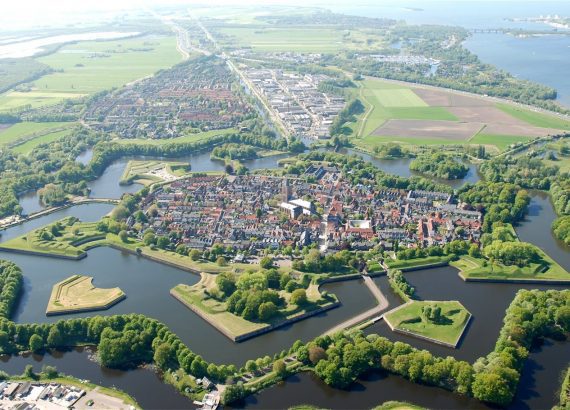
Aerial view of Naarden. Source: http://forten.nl/wp-content/uploads/2015/07/Vesting-Naarden-570x410.jpg

An instant before shrapnel came hissing over, we found ourselves on the other side of the fence lying low down against the bunker, miraculously without any damage to our clothing. I have no recollection of h
ow we got there.


---
Footnote

This incident happened on November 30, 1944. Carel had erroneously dated it September.

In the typewritten booklet referenced in the Crazy Tuesday post, the following paragraph corroborates the story above (English translation below):


The attack on the locomotive [on September 26, 1944] is not to be confused with Allied air attacks on a German munitions train in the Naardermeer on November 30, 1944. The Germans towed the burning train in segments behind the houses on the Juliana van Stolberglaan in order to use the citizen population as human shields. The train, which was equipped with anti-aircraft artillery, was again attacked from the air with rockets. In this way, the neighbourhood was again put in the firing line. The damage to the neighbourhood, caused by the burning and exploding munition, was indescribable. A detailed description is beyond the scope of this article.

The following extract from a different historical source also describes the incident, adding that residents went to look at the carnage the following day. It mentions that boys went to the site to search for grenades and cartridges and that they used these cartridges to make fireworks.


12. November 1944: Mother goes missing

There were long queues for even the most basic foods, in spite of rationing. Oma von Ziegenweidt, in her seventies, always insisted on going grocery shopping for us. When Oma queued up, people would be sympathetic, saying, “Oh, let the poor old lady go ahead.”  Oma played her age to her advantage. I suppose we were lucky because not every family had an old grandmother at their disposal.

In order to alleviate the desperate situation a little, the municipality started a soup kitchen. The problem was not only a food shortage and having to queue up for the little that was available, but also an almost complete lack of cooking fuel. Soup was prepared centrally and distributed to various distribution points throughout the town. It was made of cabbage, onions, carrots, some potatoes – and a lot of water. It was ladled out according to the number of ration coupons tendered. You also had to pay for it. You would come with an empty pan to the distribution point, where a volunteer dished out the soup. In our neighbourhood, a retired neighbour had taken on this task. One day he had a cold and a large drop was hanging from his nose. Everybody wondered in dread when this drop would fall. Luckily our soup was spared.


Line up at a soup kitchen in Amsterdam during winter of 1944-1945 Source: https://themasterforger.wordpress.com/2011/01/31/the-dutch-hunger-winter/

From time to time the Resistance would sabotage the Germans. As a precaution, the Germans had taken hostage a number of prominent people. Soon after an attack, they would shoot a couple of hostages. The Germans would paste red posters with a “Bekanntmachung” (Announcement), listing the names of the people who had been killed in reprisal. Sometimes they would simply pick people up off the street and shoot them summarily. In Tiel, they shot the eighteen year old Marcel van Tinkelenberg, whom I had visited at home because played the accordion so well. The father of my friend Jan Daalderop was somebody else who wasn't able to escape this fate. He was the managing director of a large metal products factory in Tiel. Both had lived close to our old house in Drumpt.

Together with one of her friends, Mother made three exhausting bicycle trips to the east of the country in order to find food for the family. These expeditions were both difficult and dangerous. Transporting food that had not been purchased with ration coupons was strictly forbidden. They rode on bicycles with worn-out tyres. In spite of the dangers, Mother always succeeded in bringing home potatoes, pulses, grain and rye.

Women generally wore men’s clothing during the last winter of the war, to better protect them against the cold. I still clearly remember seeing Mother wearing one of Father’s old brown three-piece suits. She wore it without the waistcoat while travelling. It was a practical solution in a time when new clothing was simply unavailable. Mother completed the look with a triangular headscarf.

One time she wasn’t planning to go far. With her friend she rode to Spakenburg, but there was nothing available. They rode on to Nijkerk and then to Harderwijk, without success. It wasn’t until they reached the province of Overijssel that they were able to buy food. At night they slept in the straw above the cowsheds or in haystacks, on condition that they first hand over to the farmer any matches they might have been carrying.

The first night, nobody worried when Mother didn't come home. The second day wasn’t too bad, but by the third day we were quite worried. Only Father, in his typical way, remained impassive. Even after a full week he showed no emotion. 

In the meanwhile, Mother had a very hard time in Overijssel. Her bicycle was heavily laden and she was very tired. The worst was that there were inspectors at the bridge across the River IJssel, and they were confiscating any food they found. 

While Mother was wondering what to do, it started to get dark and it was almost curfew.  Luckily a convoy of German troop transports drove up. Mother and her friend asked if they could catch a ride. Moments later, Mother, her friend, their bicycles and all their precious contraband were safely hidden on board the truck with the Germans. Mother and her friend sat on benches between the young men and soon a soldier rested his head on one of Mother’s shoulders, a sailor on the other. 

They were very lucky. Not only did the truck bring them safely past the inspectors and across the river, but they were brought all the way to Amersfoort. From there they rode their bicycles back home again. 

In Baarn, Mother had a puncture. She went to the police station, where the officers were good enough to patch her tyre for her. 

Eventually both women arrived home safely with their loads. 

When it was all over, Father admitted that after more than a week without word, he had been getting quite concerned.

The trips were hard on Mother’s health, weakened as she was by the food shortage. It was probably during this time that she contracted TB, although she didn't find out about it until after the liberation. 

She had to spend a full six months recuperating at home. In those days, this meant full bed rest and lots of milk. However, even after the end of the war, there was a shortage of cows and it was very difficult to find milk. Medication against TB wasn't available.


--- 
Footnote

In this same period, the 21 year old Nely Sneder wrote this descriptive letter to her friend that echoes this story:

A couple of weeks ago, all the men were ordered to present themselves to go work on the Ijssellinie. At 9am [the Germans] started to search the houses. If you didn't open the door, they blasted it open with a grenade. They had machine guns too. Two men who tried to escape were shot dead.

My father is 45, but thankfully they weren't able to catch him. After a week the men who hadn't been taken were walking about on the streets again but [the Germans] now pick them up for forced labour loading and unloading the trains. The food situation here is hopeless. No potatoes, no butter, no milk, no sugar, very little bread, etc. The smallest children are given dried milk and rapeseed oil instead of butter. That's all. You'll be wondering what we're doing to survive. There is a central soupkitchen. If you give them ration tickets, you can at least get something hot to eat every day. They serve pea, brown bean, onion and vegetable soup, but if you ask me, it's all the same. There's porridge too, but it's so thin that it's just like water. The past three Sundays we were served porridge with syrup as a treat. The whole family (except mother, my youngest brother and I) went out to glean potatoes. They got up at 6am, it was pouring rain, and they were up to their calves in mud, but they came home with almost 3 bushels. They looked like pigs! Gas and electricity stopped a while back. We cook on the heating stove, but we don't have coal. My 15 year old sister and my 12 year old brother go out to look for wood as often as possible with a saw and an axe. Last week their saw was confiscated so that's become more difficult as well.

Source: https://www.historischekringbussum.nl/images/2016/DeLaatsteLoodjesTVE2016.pdf

1. August 1939: A trip to Germany cut short

During the second half of August 1939, Father, Mother, my little sister and I were on the German island of Borkum. Father had saved some Ger...