One morning early we heard the unmistakable rumbling of plane canons. Fighter bombers were attacking a train stranded on the track, about 2 kilometers away near the Naardermeer. From the tram station I watched them diving towards their prey and then rising again in preparation for the next attack. After a while they flew off.
That morning I had to be at school at 11 am for our 'shift' in the Christian school building. By then we were sharing the building with three other schools. Around 10.40 am. I left home as usual, first jumping over the little wall in front of the garden at Prins Hendriklaan, where I met up with my classmate Kees de Roode. We walked down the street together. At Brediusdam a third classmate joined us.
Our conversation was filled with the events of that morning. We were careful, because we suspected that the planes, after re-arming in England, would come back to finish off their target of the early morning. When we reached the end of Land Street, our expectations were confirmed. We saw four fighter bombers flying at an altitude of about 3,000 feet. They were flying in the opposite direction from the station. When we were almost at the school, the first plane broke formation and started to dive.
Our conversation was filled with the events of that morning. We were careful, because we suspected that the planes, after re-arming in England, would come back to finish off their target of the early morning. When we reached the end of Land Street, our expectations were confirmed. We saw four fighter bombers flying at an altitude of about 3,000 feet. They were flying in the opposite direction from the station. When we were almost at the school, the first plane broke formation and started to dive.
I still clearly recall the scene. One moment the schoolyard was full of pupils, all looking up. Then, all of a sudden, everybody ran inside as fast as they could. We three also took flight, running to a bicycle shop across the road. There were no longer any bicycles for sale, but the door was open. Without asking, we ran inside and dived down the basement stairs. A couple of people were already lying on the floor.
Seconds later, we heard the rattle of machine gun fire coming from the German anti-aircraft guns, followed by heavy explosions. Two women in the basement began to scream. Shortly afterwards, the all-clear siren sounded and we got up and made our way to school.
Seconds later, we heard the rattle of machine gun fire coming from the German anti-aircraft guns, followed by heavy explosions. Two women in the basement began to scream. Shortly afterwards, the all-clear siren sounded and we got up and made our way to school.
Our lessons began as if nothing out of the ordinary had happened. It didn't take long before we heard another explosion, this time much bigger than before. The windows rattled. Ten minutes later there was another explosion. Still our lessons continued. That is, until the seventh heavy explosion, which shattered a window pane.
At that point, the principal came in to tell us it might be a good idea to go home.
On my way back I encountered my parents, my sister and little brother, Oma, Miss Brouer and Senta, our housekeeper at Brediusdam. They had to evacuate the area because of a dud.
At that point, the principal came in to tell us it might be a good idea to go home.
On my way back I encountered my parents, my sister and little brother, Oma, Miss Brouer and Senta, our housekeeper at Brediusdam. They had to evacuate the area because of a dud.
The exploding bombs that we had heard at school had landed right in front of our house. Senta happened to be near a window on the second floor at the time. Suddenly she heard a deafening noise of an aeroplane above her and saw a dark shadow. Almost simultaneously, there was a tremendous blast. Bombs had fallen 5 metres outside the retaining wall of our front garden, exactly where I had started my walk to school earlier that morning. Several people were wounded and two were killed.
Miraculously, our building was hardly damaged, probably because of the protecting brick wall. Only some window panes were broken and the lamp in Father's office had come down from the ceiling, while Father was talking to a client.
True to form, Father finished his conversation shortly soon after that, as if nothing had happened.
 |
| The house still has a low retaining wall today |
Miraculously, our building was hardly damaged, probably because of the protecting brick wall. Only some window panes were broken and the lamp in Father's office had come down from the ceiling, while Father was talking to a client.
True to form, Father finished his conversation shortly soon after that, as if nothing had happened.
One of the bombs had landed without exploding and had to be removed by the bomb disposal unit. The inhabitants had to leave the area during the operation. This is why I came across my family at Brediusdam. I suggested going to the Zanen family who would be happy to have us. By afternoon we were allowed to go back home.
It wasn't until later that we heard the whole story. The Germans had hauled the train which had been attacked earlier that morning, to within the Naarden city limits. Presumably they thought this would protect it against further air raids. The train was filled with explosives consisting of heavy artillery grenades and cartridges. During the second attack it had caught fire, causing one truck after the other to explode. Those were the explosions we had heard from the school. The explosions badly damaged the houses nearest to the track. Some lost their roofs and walls were split open. All the windows had shattered and most of the roof tiles were gone.
The extent of the damage is still visible when you drive past by train. In view of the shortage in building materials in 1945/46, the original dark blue tiles were not available at the time and were replaced by red ones. Even today, this has still not been corrected.
A couple of days after the attack, my friend Dick Geuzenbroek and I went to look at the destruction. The little park between the houses and the railway was littered with the remains of the train, mainly heavy grenades and cartridges. Inside each cartridge was an imitation-silk bag filled with explosives, consisting of brittle black hollow rods about 35cm in length and 0.8 cm in diameter. When lit, they burned brightly, so they made wonderful fireworks. However, you would never use them to light a fire in the coal stove, because insufficient oxygen would cause them to explode.
The train itself was almost completely destroyed. All that was left were two half-burned out passenger coaches and the remains of the mangled trucks. I removed a ‘no smoking’ sign from one of the coaches. The steam engine was also heavily damaged. When we opened the steel door in the front under the chimney, we found an unexploded grenade. It was a mystery how it came to be there.
We were there to look for sleepers, of which a great number were lying around. With a spanner, we removed the steel brackets. Creosote wood was ideal for heating. We brought home the sleepers with a makeshift two-wheeled cart with quite an effort, and sawed them into blocks to be chopped.
We were there to look for sleepers, of which a great number were lying around. With a spanner, we removed the steel brackets. Creosote wood was ideal for heating. We brought home the sleepers with a makeshift two-wheeled cart with quite an effort, and sawed them into blocks to be chopped.
By then, we had already been cooking with wood for quite a while. On the stove in the living room we had a cylindrical 40 cm high cooker, fueled with wood chips, over which a little pan could be used. The creosote oil from the sleepers caused the fire to burn much more brightly. There was never enough heat to warm the room, even though we always sat close to the fire. Perhaps the illusion of coziness was more effective than the reality.
Many of the grenades in the train hadn't exploded. It wasn’t long before workers were sent out to clear the area. All unexploded ammunition was dumped into a large hole in the ground near the Karnemelksloot.
When I later took a walk with a friend to the old fortress of Naarden about a kilometre away, we saw the whole lot going up into the air. We realised we could expect low-flying shrapnel. Close by was an ancient bunker of the 17th century fortress, against which we could shelter. There was a one-and-a-half metre barbed-wire fence between the bunker and us.
An instant before shrapnel came hissing over, we found ourselves on the other side of the fence lying low down against the bunker, miraculously without any damage to our clothing. I have no recollection of how we got there.
---
Footnote
This incident happened on November 30, 1944. Carel had erroneously dated it September.
In the typewritten booklet referenced in the Crazy Tuesday post, the following paragraph corroborates the story above (English translation below):

The attack on the locomotive [on September 26, 1944] is not to be confused with Allied air attacks on a German munitions train in the Naardermeer on November 30, 1944. The Germans towed the burning train in segments behind the houses on the Juliana van Stolberglaan in order to use the citizen population as human shields. The train, which was equipped with anti-aircraft artillery, was again attacked from the air with rockets. In this way, the neighbourhood was again put in the firing line. The damage to the neighbourhood, caused by the burning and exploding munition, was indescribable. A detailed description is beyond the scope of this article.
The following extract from a different historical source also describes the incident, adding that residents went to look at the carnage the following day. It mentions that boys went to the site to search for grenades and cartridges and that they used these cartridges to make fireworks.

When I later took a walk with a friend to the old fortress of Naarden about a kilometre away, we saw the whole lot going up into the air. We realised we could expect low-flying shrapnel. Close by was an ancient bunker of the 17th century fortress, against which we could shelter. There was a one-and-a-half metre barbed-wire fence between the bunker and us.
 |
| One of the many ancient bunkers in Naarden's fortress. Source: http://forten.nl/wp-content/uploads/2015/03/Naarden-Vesting-570x410.jpg |
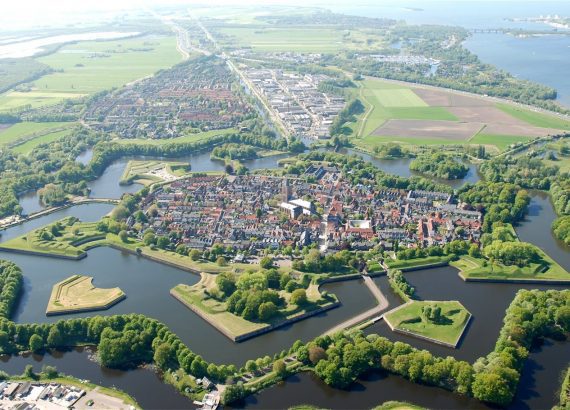 |
| Aerial view of Naarden. Source: http://forten.nl/wp-content/uploads/2015/07/Vesting-Naarden-570x410.jpg |
An instant before shrapnel came hissing over, we found ourselves on the other side of the fence lying low down against the bunker, miraculously without any damage to our clothing. I have no recollection of how we got there.
---
Footnote
This incident happened on November 30, 1944. Carel had erroneously dated it September.
In the typewritten booklet referenced in the Crazy Tuesday post, the following paragraph corroborates the story above (English translation below):

The following extract from a different historical source also describes the incident, adding that residents went to look at the carnage the following day. It mentions that boys went to the site to search for grenades and cartridges and that they used these cartridges to make fireworks.


No comments:
Post a Comment